AviationChapter 1 of 86
From mail contracts to SABRE
Most of what looks strange in airline reservation systems today started with a single seat on a mail plane in 1925. This chapter is about why inventory and the passenger record were born apart, and why that split still costs us.
Aviation · Contents
- Origins
- 01From mail contracts to SABRE
- 02From SABRE to PSS: why one architecture lived 60 years
- 031978: when the profit guarantee ended, revenue management was born
- Revenue management
- 04Yield management: the early strategy and its business logic
- 05Yield management: competitive strategy and the PEOPLExpress case
- 06Revenue management and strategic operations: PEOPLExpress and American Airlines
- 07PEOPLExpress and the industry: loyalty programmes and distribution systems
- Distribution
- 08Airline reservation and global distribution systems (GDS): strategic evolution and business logic
- 09Aviation industry standards and governance: a strategic analysis
- 10GDS and the airline distribution ecosystem: strategy and business logic
- 11Airline reservation systems and digital distribution channels: a strategic analysis
- Retailing
- 12The travel value chain and distribution channels: a strategic briefing
- 13The travel distribution ecosystem and New Distribution Capability (NDC)
- 14NDC@Scale: transformation and business logic in airline distribution
- Operations
- 15Airline marketing planning: process and business logic
- 16Airline planning and revenue management: a strategic analysis
- 17Revenue management and competitive strategy in aviation: a business logic analysis through Sun Tzu's principles
- Fares and pricing
- 18Airline pricing and yield management strategies: an analytical view
- 19Airline fare products and their business logic
- 20Classifying airline fare products: strategic analysis and business logic
- 21Airline distribution channels and fare rules: a strategic analysis
- 22Airline fare rules and journey types: a strategic analysis
- 23Itinerary pricing in aviation: business logic analysis
- 24Fare construction, segmentation and loyalty programs analysis
- 25Special fares and price elasticity in aviation
- 26Fare management and planning strategies in aviation
- 27Reactive pricing process and strategic decision mechanisms
- 28Proactive pricing and fare rationalization: a strategic business logic analysis
- 29Revenue sharing in aviation: multilateral and special prorate agreements (MPA and SPA)
- 30Airline ancillaries and their business logic
- 31Airline revenue management and fare structures
- Forecasting
- 32The airline spill model and its business logic
- 33Expected spill and the Boeing spill model
- 34Aviation demand forecasting and spill models analysis
- 35Expected spill and demand analysis in revenue management
- 36Calibrating input parameters for airline spill models
- 37Capacity management and spill (lost demand) analysis in aviation
- 38Nominal load factor and spill analysis
- 39High-variance demand and the two-stage Coxian distribution
- 40Measuring spill with the two-stage Cox distribution
- 41The airline industry and revenue management: an analysis
- 42Airline revenue management alternatives and business logic analysis
- 43Revenue improvement and forecast accuracy: demand forecasting in two-dimensional time
- 44Booking profiles and demand forecasting
- 45Clustering booking profiles and analysing cancellation rates
- 46Demand profiles and data cleansing in revenue management
- 47Demand forecasting and unconstrained demand in revenue management
- 48Airline demand forecasting and time series analysis
- 49Forecasting models in revenue management and their business logic
- 50Airline revenue management: booking forecasting and demand analysis
- 51O&D demand forecasting: first- and second-generation approaches
- 52Competitive airline shopping data analysis
- 53Data-driven business logic and decision support systems in aviation
- 54Airline revenue management and consumer choice modeling
- 55Itinerary choice models and demand analysis
- 56O&D forecasting and the must-forecast list
- Inventory and availability
- 57Overbooking strategies and operational analysis in aviation and hospitality
- 58Show-rate forecasting and overbooking strategies
- 59Overbooking and show-up modeling strategies in aviation
- 60Overbooking strategies and revenue management in aviation
- 61Discount allocation controls, Littlewood's rule and the Gamma demand model
- 62Gamma distribution and discount allocation: protection levels and revenue ratios
- 63Discount allocation and booking optimization: EMSR and integrated overbooking
- 64Reservation inventory control and revenue management
- 65Mixed and hybrid inventory control systems
- 66Airline revenue management: inventory control and business logic
- 67Shared cabin inventory and funnel flights
- 68Measuring airline revenue management performance
- 69The revenue opportunity model (ROM) and measuring airline revenue management performance
- 70Critical state identification and O&D strategies in revenue management
- 71Airline inventory control strategies and network effects
- 72Airline revenue management: an analysis of virtual nesting
- 73Virtual nesting and dual indexing: who gets the seat in airline inventory
- 74Dynamic virtual nesting and revenue management analysis
- 75Airline revenue management and O&D optimization: virtual nesting and CER
- 76Continuous nesting and bid price control systems
- 77Airline revenue management: network optimization models
- 78Network optimization and leg decomposition in revenue management
- 79Airline revenue management and network optimization strategies
- 80O&D revenue management and seat availability calculation
- 81Fare qualification rules in passenger valuation
- 82Airline revenue management and inventory control systems: a post-process nesting analysis
- Offers and merchandising
- 83Branded fare families and connectivity architecture
- 84Airline inventory management and GDS integration systems
- 85Airline inventory control and O&D management
- 86Airline reservation and inventory management: strategic business logic analysis
The first question anyone asks when they open an airline reservation system is always the same: how hard can it be to keep a seat and a passenger in one table, and why is all of this such a mess?
The answer is a single seat on a mail plane in 1925.

The passenger was a by-product
The 1925 Kelly Act ended the Post Office monopoly and opened airmail to private carriers. The point of the flight was to carry mail; exactly one seat was set aside for a paying passenger. A traveller called the departure city, and if the seat was free, it was booked.
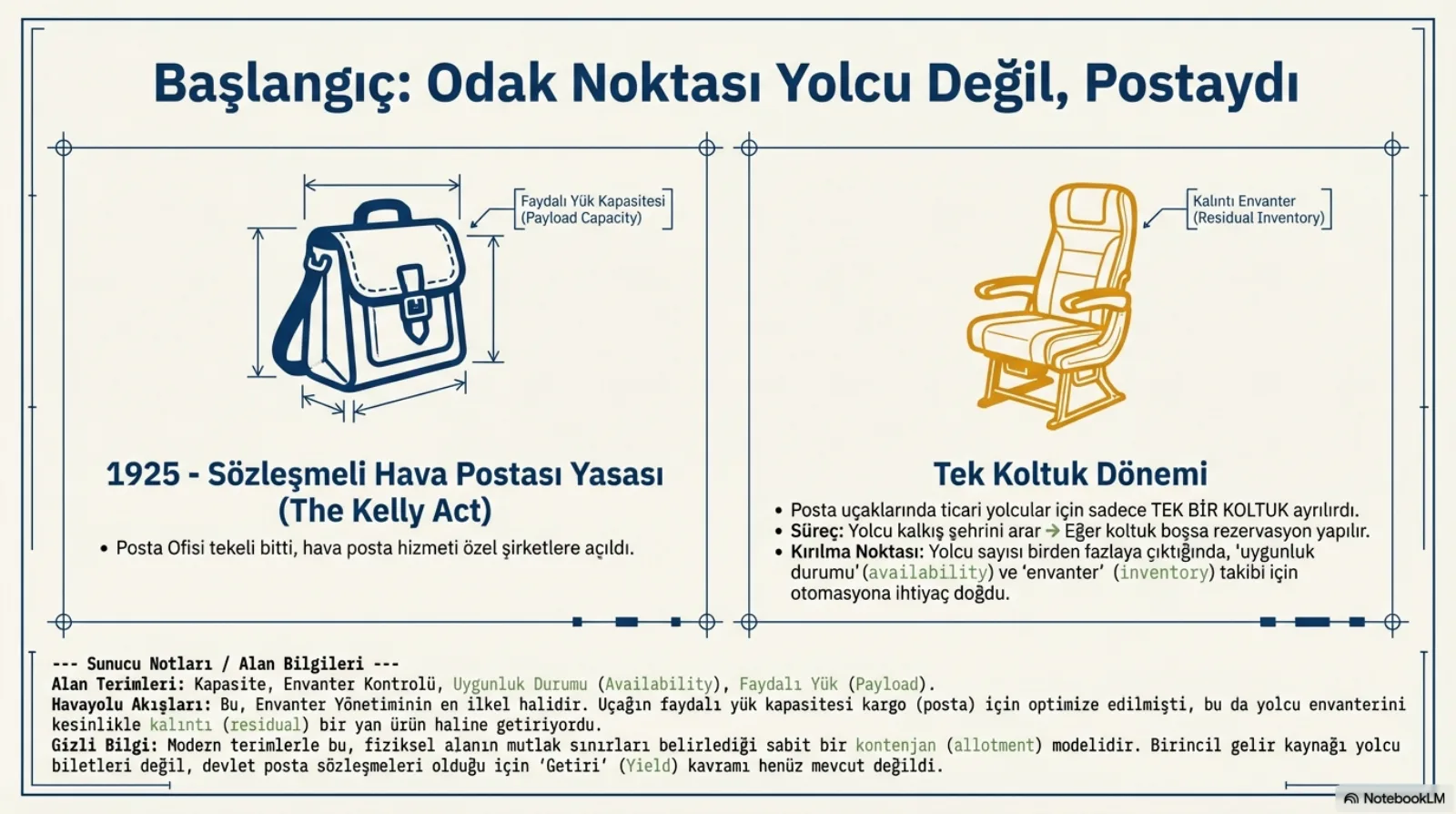
The business logic matters here. The aircraft’s payload was optimised for cargo, so passenger inventory was the residue. In modern terms it is a fixed allotment: the physical space is the limit. And since revenue came from a government mail contract, yield did not exist as a concept. Price was not something you optimised — it was a number written in a contract.
Who knows the inventory
Early inventory control was not centralised. The true state of the seats was known by the station in the city the aircraft departed from. Before making a booking, a sales agent had to call that station and get confirmation: request and reply. The answer went onto a PNR card and moved by teletype.
It was correct, and it was slow. Every sale cost a phone call.
The fix arrived in Boston in 1939: sell and report. Agents sold freely without asking, up to a threshold of fullness; once the threshold was crossed a “stop sale” message went out and the system fell back to the slow, safe method.
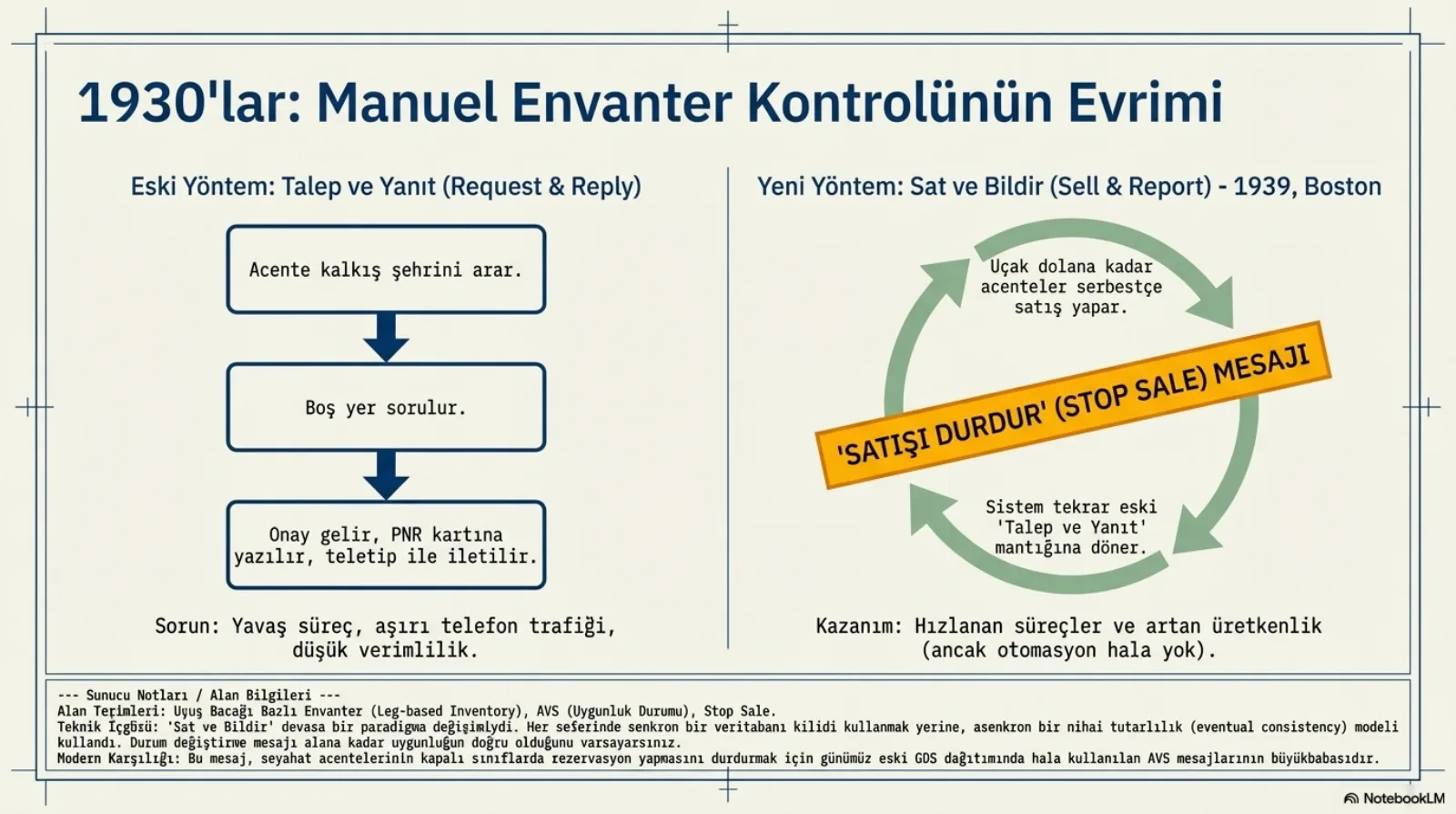
Read that in today’s vocabulary and it is obvious what happened: instead of taking a synchronous lock on every sale, they moved to eventual consistency.1
The efficiency argument is also the modern one: management by exception. You start the message traffic only near the limit, not on every transaction.
The buffer seat: when sync is slow, you hide inventory
Post-war traffic grew while the process stayed old. The Boston Reservisor (1946) was the first machine to replace the card files; the Magnetronic Reservisor (1952) went in at LaGuardia and held ten days of data for a thousand flights, queryable by several people at once.
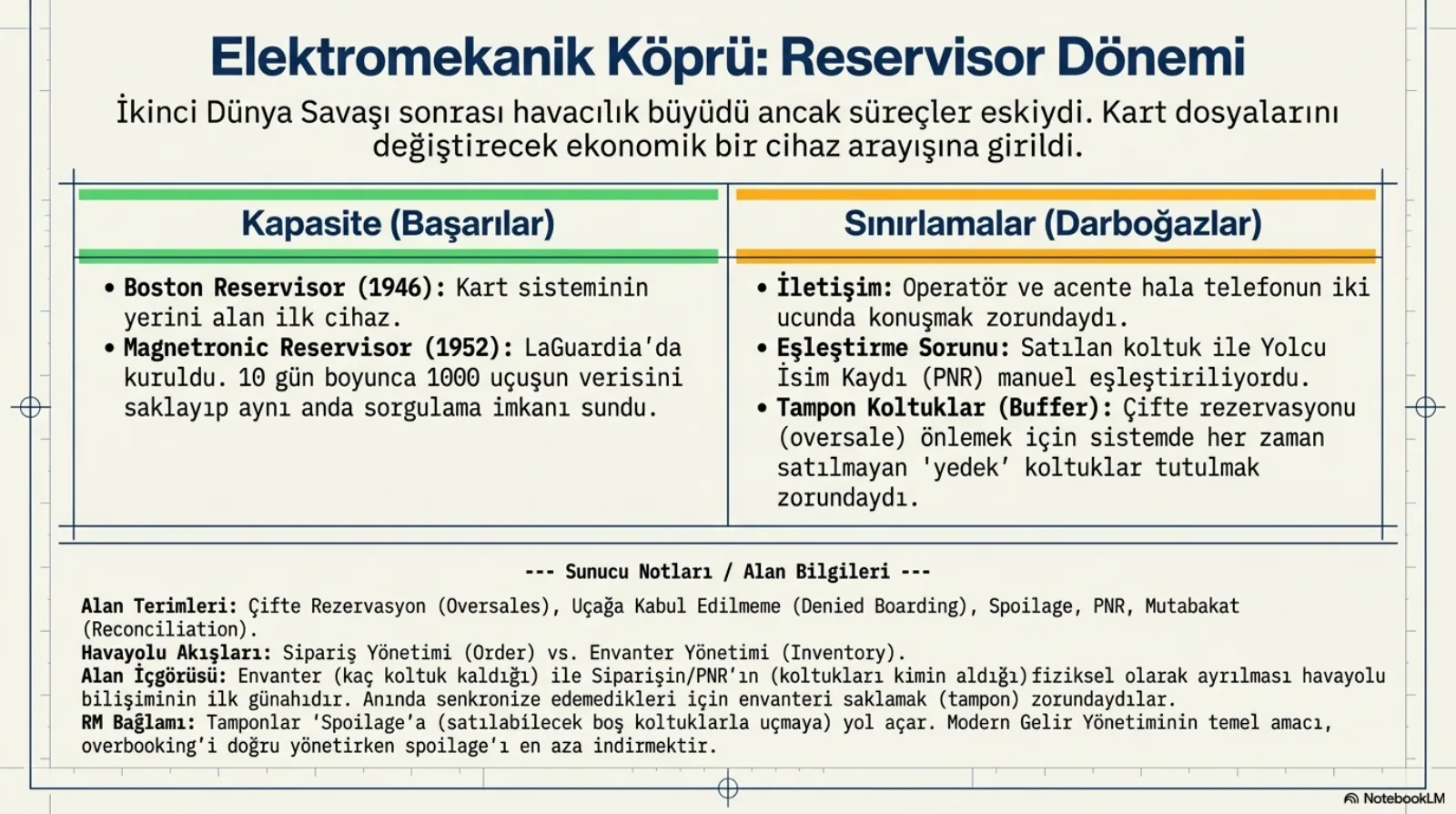
But the machine solved less than half the problem. The agent and the operator were still on two ends of a telephone, and more importantly: the seat sold and the passenger name record were matched by hand.
The business rule that came out of this will sound familiar. Because inventory and record could not be synchronised in the moment, the last few seats were closed to sale and a buffer was kept. That was how oversales and denied boarding were managed.
A buffer is not free. It means flying with empty seats — the industry calls it spoilage.2
If the fare is fixed, revenue management cannot exist
From 1938 until the late 1970s the Civil Aeronautics Board ran the industry at the micro level: which carrier flew which route, what a ticket on it cost, whether a merger was allowed.
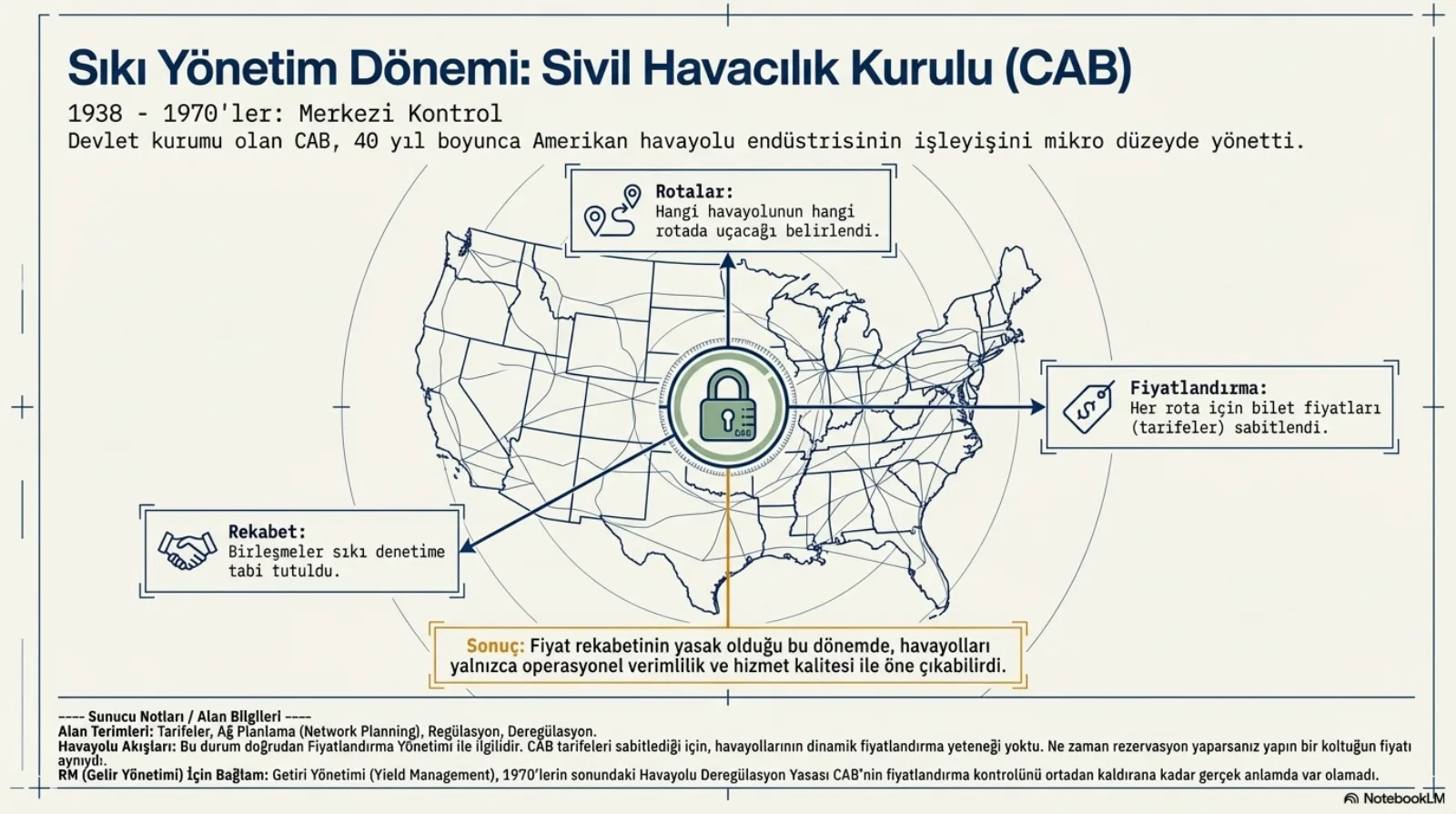
It is odd to find this in a technical chapter, and it is decisive. If the tariff is fixed, dynamic pricing is not a problem you have. Whenever you book, the seat costs the same. Yield management could not exist until deregulation removed the CAB’s pricing control — not because the technology was missing, but because the rule forbade it.
Worth remembering when you look at what a system does not solve: some features are not missing, they are prohibited.
The real idea: bind inventory to the customer
In 1953 C.R. Smith, the CEO of American Airlines, and a young IBM salesman named R. Blair Smith sat next to each other on a flight. The machine Blair Smith described would not just hold availability; it could record the passenger’s name, their itinerary, even their phone number.
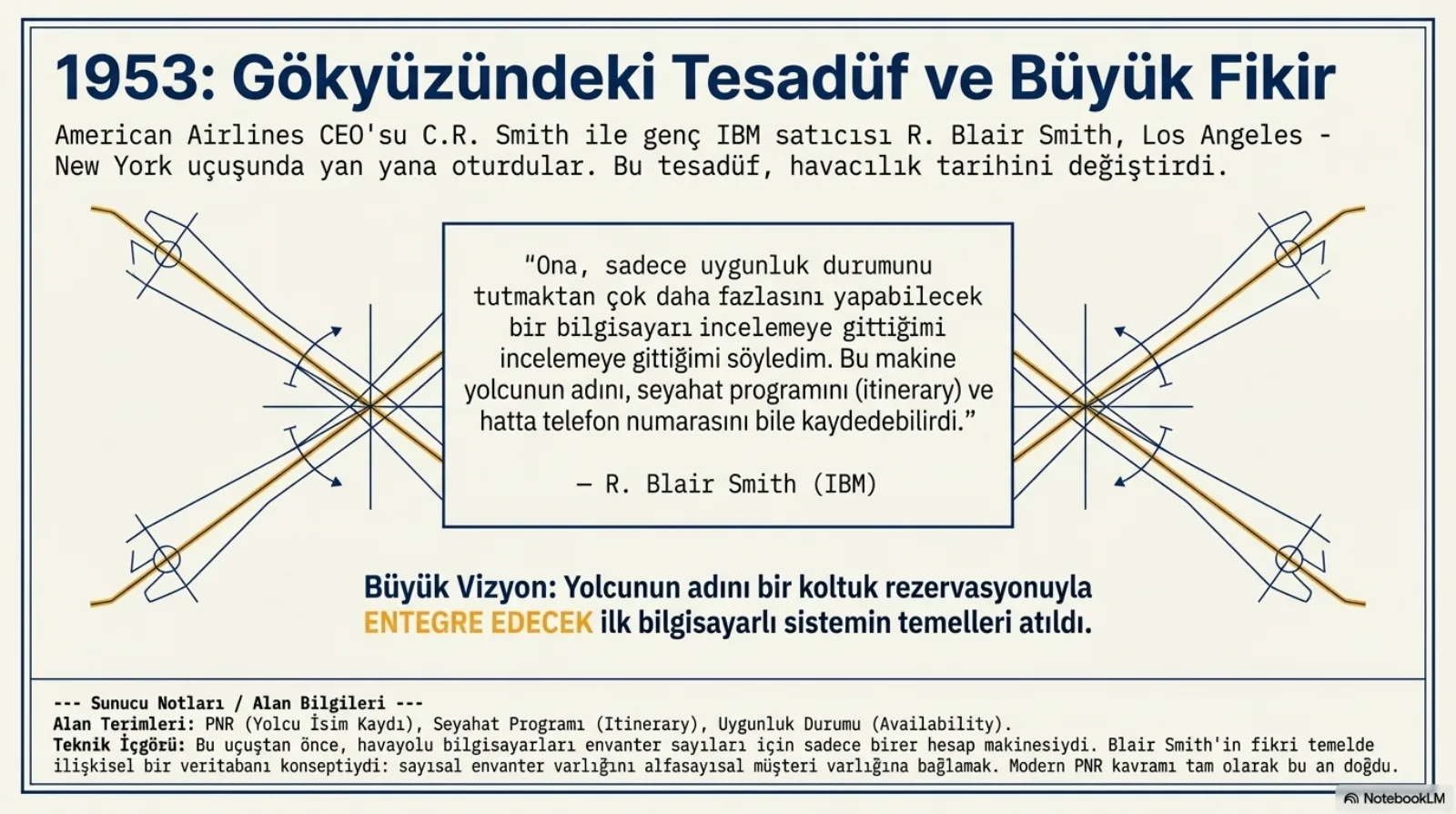
Until then, airline computers were calculators for inventory counts. The idea was, at bottom, a relational database idea: bind a numeric inventory entity to an alphanumeric customer entity. The modern PNR was born there.
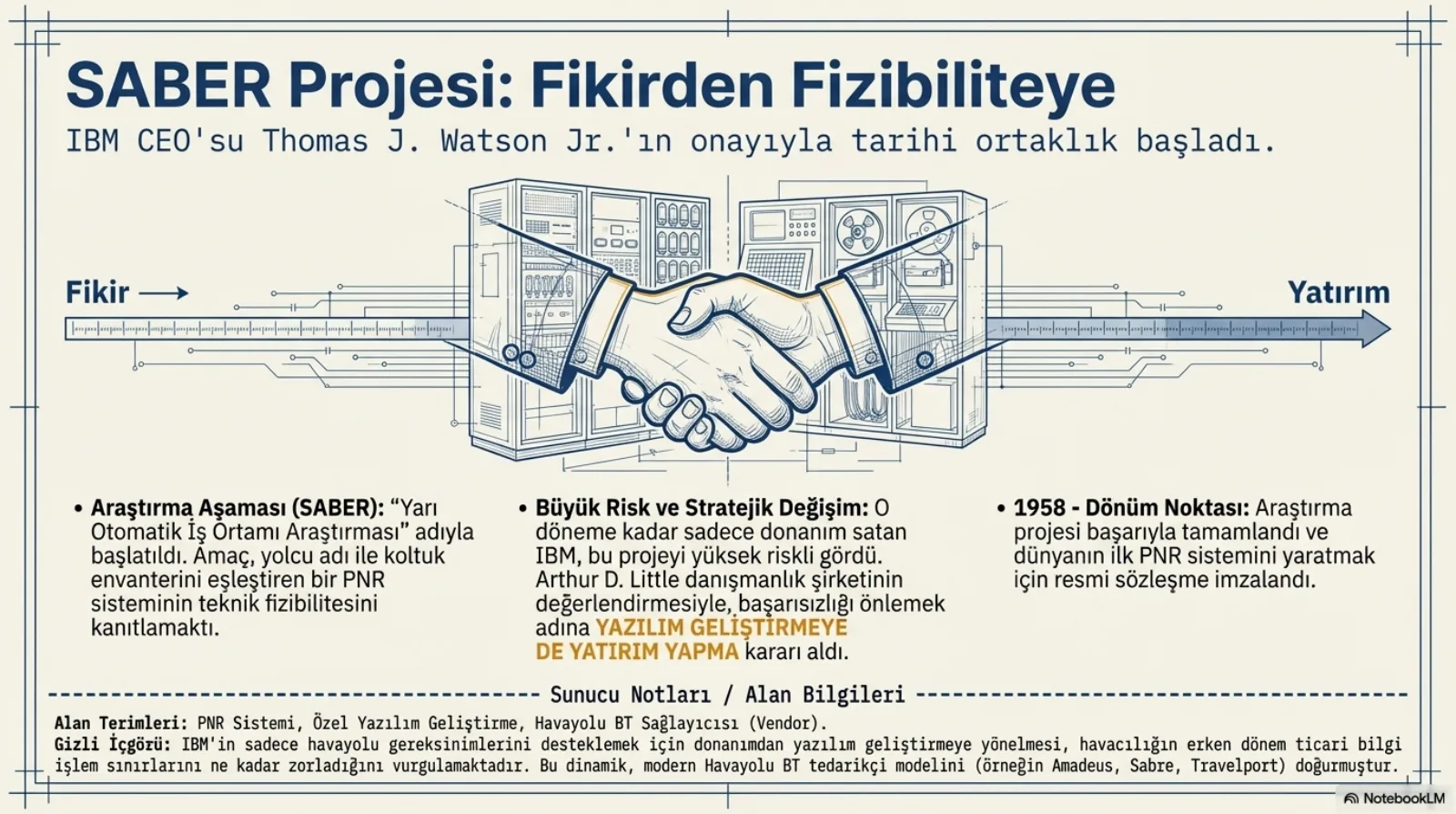
An IBM that moved from hardware into software purely to serve one airline’s requirement is also the start of the airline IT vendor model. Amadeus, Sabre, Travelport — all descendants of that decision.
The technical foundation came from the military. SAGE, the air defence system built to track aircraft, turned out to be the right infrastructure for tracking seats.
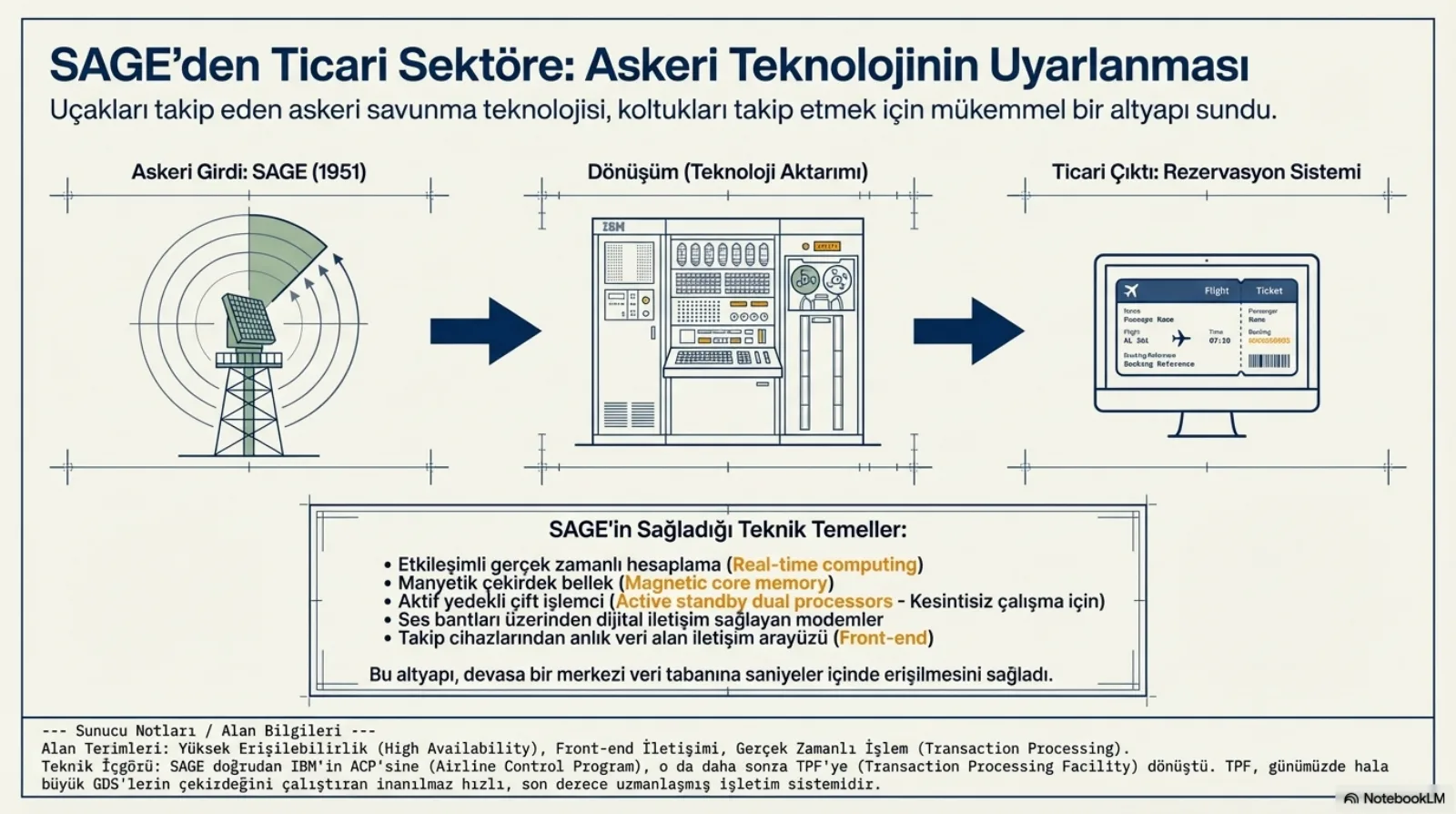
SAGE became IBM’s ACP; ACP became TPF. TPF still runs inside the big GDSs today — a sixty-year-old operating system, still in production.3
A decision made in 1961 is still standing
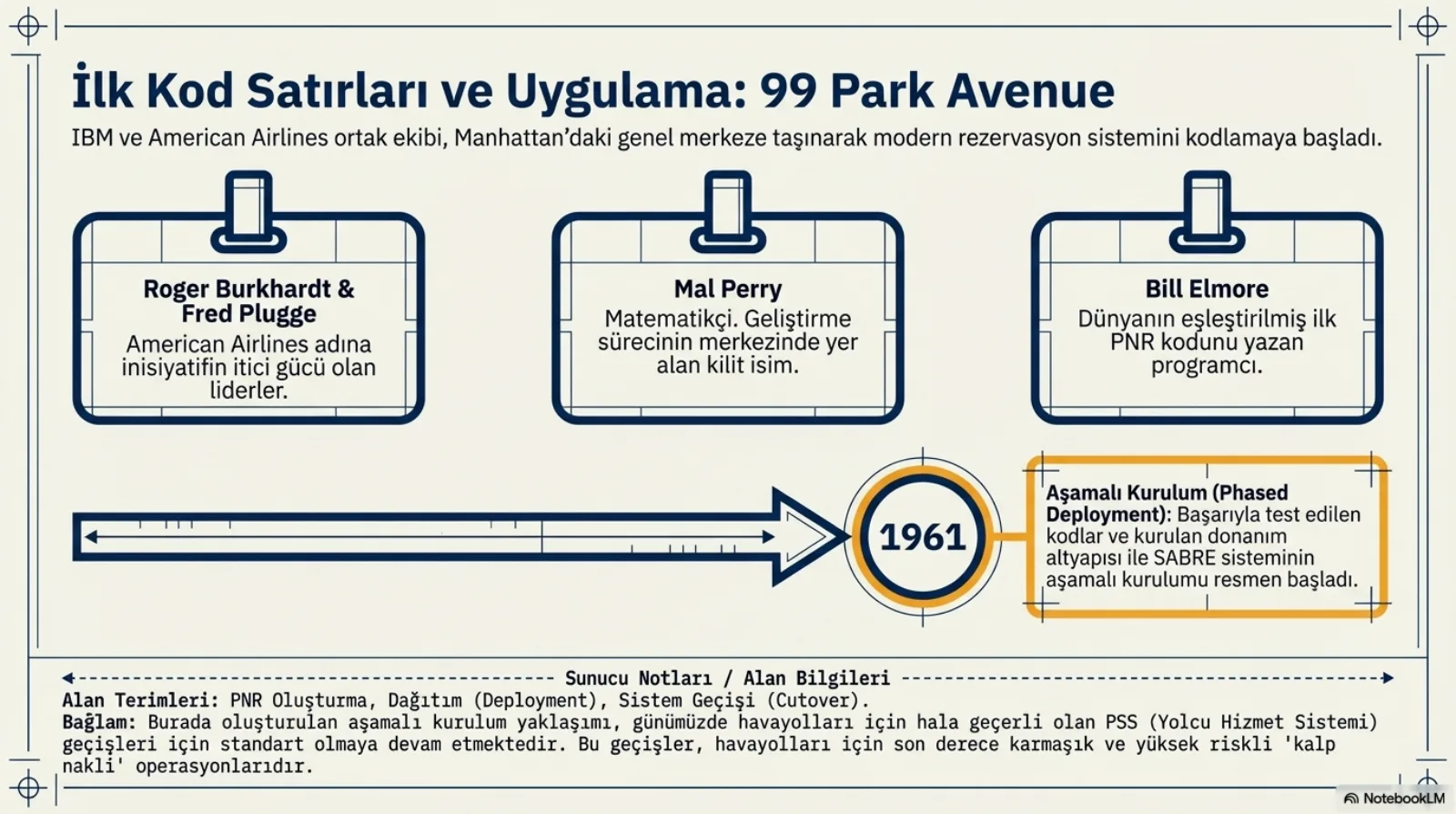
SABRE’s architecture left five modules behind: schedules, inventory, PNR, ticketing and DCS. Each answers its own question — where and when do we fly, how many seats can be sold, who is the passenger, what was paid, who boarded.
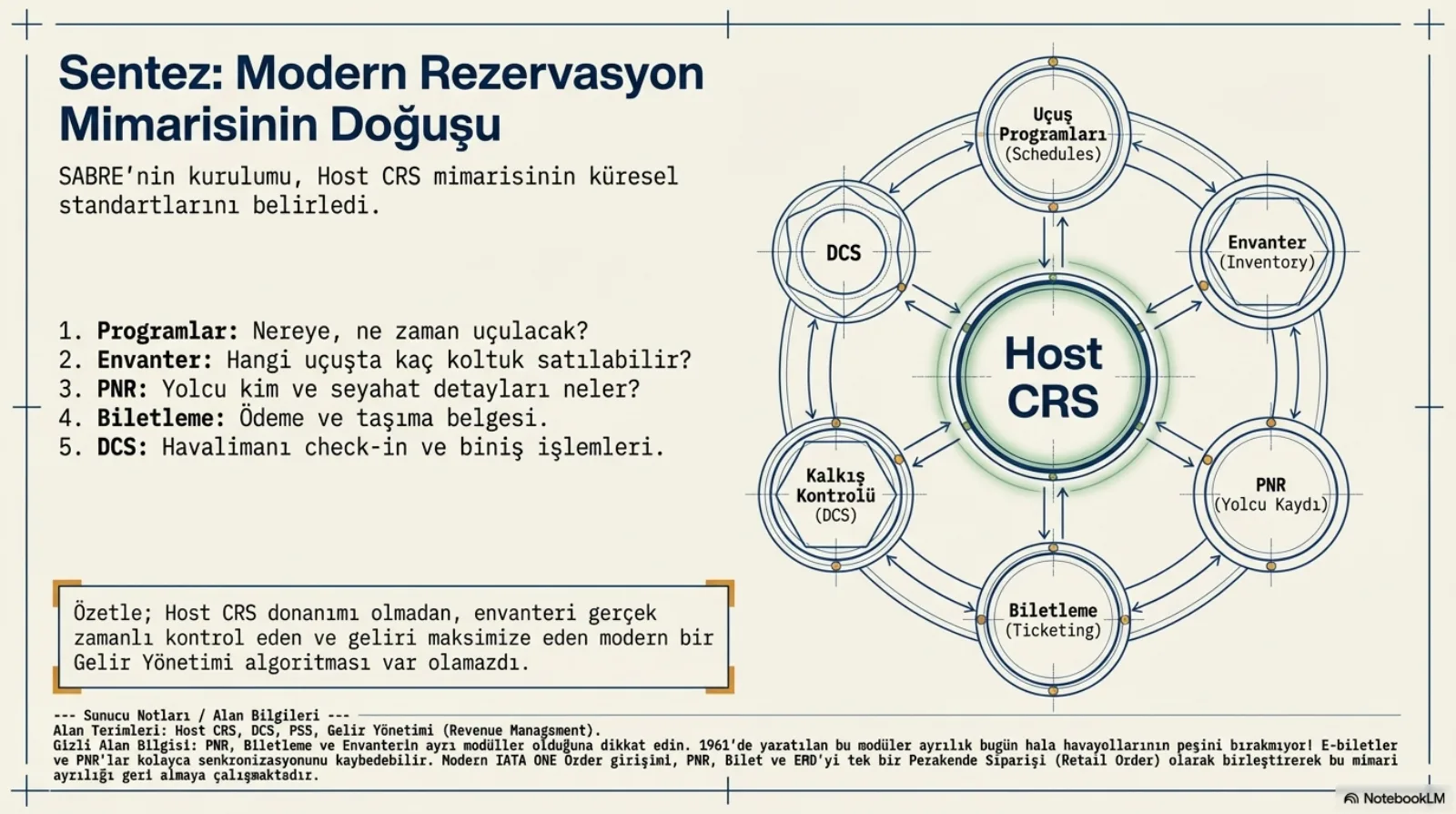
Here is the part to notice: PNR, ticketing and inventory are separate modules. That was decided in 1961 and we are still paying for it. An e-ticket and a PNR can drift out of sync because the architecture gave birth to them apart. IATA’s ONE Order initiative is an attempt to undo exactly that split: collapse the PNR, the ticket and the EMD into a single retail order.
Sixty years later, we are trying to reverse a modularisation decision.
What it leaves us
Three things, and none of them are specific to aviation.
When synchronisation is slow, you hide inventory. The buffer seat is not incompetence, it is the invoice for latency. If you hold safety stock in your own system you are paying the same invoice; the question is not “how do I reduce the stock” but “why can’t I make the sync faster”.
The constraint is not always technical. What was missing in the CAB era was not an algorithm, it was permission. Before you explain what a system fails to do, ask what it was allowed to do.
Boundary decisions made early live longest. Separating inventory from the record was the right call in 1952; undoing it in 2026 takes an international standards initiative. What you split today stays split.
Footnotes
-
Nobody called it that in 1939, but that is what it was: instead of guaranteeing correctness on every transaction, you wait for a message that tells you when it is wrong. The name arrived forty years later. Availability is assumed correct until a message says otherwise. The idea is still in the field — the AVS messages in legacy GDS distribution are the grandchildren of that stop sale. ↩
-
Spoilage and overbooking are two sides of one coin: flying empty versus selling too many. Revenue management is the job of choosing a point between them. The one-sentence definition of modern revenue management comes from here: minimise spoilage while managing overbooking correctly. Both are invoices for the same synchronisation problem. ↩
-
The longest-lived piece of software in this chapter. It was born in an air defence system and it is still selling tickets. ↩